


Neuroscience
Neuroplasticity: the brain’s amazing ability to change
A few decades ago science held that the adult brain was hard-wired. Modern neuroscience has overturned that view entirely.
- Published
- Reading time
- 22 min read
- Available in:
- UA · EN · ES
Learning Objectives
- Define neuroplasticity and describe its main types — synaptic, structural, and functional.
- Explain the neurobiological mechanisms through which the brain physically changes itself throughout life.
- Give examples of neuroplasticity from research and everyday experience — from learning a language to recovering from a stroke.
- List the key lifestyle factors that stimulate — or suppress — neuroplasticity.
- Explain why plasticity can work against a person as well as for them, reinforcing bad habits and age-related decline.
- Describe the role of neuroplasticity in preventing dementia, Alzheimer's disease, and Parkinson's disease.
- Formulate practical, evidence-based recommendations for consciously training the brain.
Introduction
Imagine being offered a single "superpower" to keep for the rest of your life. Superhuman strength? A photographic memory? Most neuroscientists would probably choose something less flashy but far more powerful: the brain's ability to change. This property is called neuroplasticity, and it is what allows a child to learn to walk, an adult to master a new profession at forty, and a stroke survivor to relearn how to hold a spoon.
Just a few decades ago, science told a very different story. It was widely believed that the adult brain was a finished, "hard-wired" structure: the neurons formed in childhood and adolescence stayed fixed for the rest of life, and any loss was permanent. Although false, this idea shaped clinical practice for a long time — doctors saw little point in intensive rehabilitation after severe brain injuries, since there was supposedly "nothing left to recover."
Modern neuroscience has completely overturned this view. The brain turns out to be not a static "computer" with a fixed wiring diagram, but a living, dynamic system that continuously rebuilds itself in response to experience, learning, injury, and even its own thoughts. This article is about exactly how that rebuilding happens, why it remains possible at any age, which factors stimulate it and which suppress it, and what all of this means for each of us personally.
From the "Frozen Brain" to a Scientific Revolution: A Brief History of Neuroplasticity
In the late nineteenth century, the Spanish neuroanatomist Santiago Ramón y Cajal — one of the founders of modern neuroscience — described neurons as separate, clearly delineated cells, and also proposed that the adult nervous system was no longer capable of forming new elements. This claim shaped scientific and medical thinking for decades, cementing the belief that the adult brain was a fixed structure.
The first cracks in this dogma appeared in the second half of the twentieth century. Studies of the visual cortex in kittens and monkeys showed that the brain is extraordinarily sensitive to experience during so-called "critical periods" of development — meaning it is capable of change under the influence of external input. Later, neurophysiologists studying the somatosensory cortex of monkeys demonstrated something even more striking: the brain regions that process signals from individual fingers can "redistribute" themselves among neighboring zones if one finger stops receiving stimulation. This was structural, not merely functional, reorganization of the adult brain.
In parallel, the cellular mechanisms of plasticity were studied in much simpler nervous systems. Research on synaptic transmission in the neurons of the sea slug Aplysia californica — work that later earned a Nobel Prize — showed that memory and learning are physically encoded in the strength of connections between neurons, and that this strength can grow or weaken depending on how actively the neurons "communicate" with one another.
The final, and perhaps most counterintuitive, blow to the old paradigm came with the discovery of adult neurogenesis — the brain's ability to create new neurons after development has finished. It turned out that in at least one brain region, the hippocampus, new nerve cells form throughout a person's entire life. Today these discoveries form the foundation of an entire field: the neuroscience of learning, rehabilitation, and healthy aging.
Mechanisms of Neuroplasticity: How the Brain Changes Itself
Neuroplasticity is not a single phenomenon but an umbrella term for several distinct processes that occur at different levels of brain organization — from a single synapse to large functional networks.
Synaptic Plasticity
The smallest and fastest level of plasticity is a change in the strength of the connection between two neurons at a synapse, the point where they make contact. When two neurons are regularly activated at the same time, the connection between them strengthens — a principle often summarized as "neurons that fire together wire together." The mechanism behind this strengthening is called long-term potentiation (LTP): after intense joint activity, a synapse becomes more sensitive and transmits signals efficiently even with weaker stimulation. There is also a reverse process — long-term depression (LTD) — in which rarely used connections weaken. Together, LTP and LTD allow the brain to literally rewrite the map of its own priorities in response to experience.
Structural Plasticity
If synaptic plasticity is a change in the strength of existing connections, structural plasticity is a physical rebuilding of the neuron's own "architecture." Dendrites — the branching extensions that receive signals — can grow new dendritic spines, tiny protrusions on which new synapses form; this process is called synaptogenesis. Axons, in turn, can sprout new branches toward other cells. At the same time, the opposite mechanism is also at work: synaptic pruning, in which connections the brain has not used for a long time gradually weaken and disappear. This is a normal and important process — it makes neural networks more efficient by removing the "noise" of rarely needed connections — but it is exactly why the principle "use it or lose it" describes the brain's operation so precisely.
Neurogenesis
The most "sensational" mechanism of plasticity is the formation of entirely new neurons from neural stem cells in the adult brain. In humans, this process has been confirmed primarily in the dentate gyrus of the hippocampus — a region critical for forming new memories and for spatial orientation — and, to some extent, in the subventricular zone. New hippocampal neurons quickly integrate into existing networks through synaptogenesis, and researchers believe it is precisely this "fresh" tissue that makes the ongoing renewal of our capacity to remember new information possible.
Functional (Cortical) Plasticity
At the level of large brain regions, plasticity shows up as the ability to redistribute functions across different areas of the cortex. The clearest example is what happens after brain injury: neighboring or even distant regions can partially take over the role of damaged tissue, allowing a person to regain speech, movement, or sensation. A similar "remapping" is also seen in people who have lost one of their senses, when the cortex that once processed that type of information reorients itself to serve the remaining, intact senses.
Observational Learning and Mirror Neurons
One more mechanism deserves special mention: mirror neurons, cells that activate not only when we perform an action ourselves but also when we watch someone else perform it. Mirror neuron systems are thought to play a role in learning through imitation and in empathy — the ability to "sense" another person's emotional state — making them yet another way social experience shapes the brain's neural networks.
Neuroplasticity in Action: Examples from Science and Life
Abstract mechanisms become tangible when you see how they show up in real life.
Sensory compensation. In people who have lost their sight, the visual cortex does not simply sit idle — it becomes actively involved in processing auditory and tactile information. This is why many blind people show heightened sound perception and remarkable finger sensitivity when reading Braille: the brain regions freed from their original function have taken on a new role.
Recovery after stroke. When a stroke damages a brain region responsible for, say, arm movement, the weeks and months of rehabilitation that follow are not just "physical therapy" — they are literally training in neuroplasticity. Intensive, repeated exercises push neighboring healthy regions to take over the lost function, forming new neural pathways that route around the damaged tissue. The more intensive and earlier the rehabilitation begins, the higher the chances of functional recovery.
Musicians and polyglots. Studies of professional musicians' brains consistently find enlarged cortical regions associated with fine finger motor control and auditory processing, compared with people who have never played an instrument. Similarly, learning a new language in adulthood builds new neural pathways devoted to processing grammar, vocabulary, and pronunciation — the brain is literally laying new infrastructure to support the new skill.
A brain that heals itself. Clinical observations of patients with severe brain injuries and neurological conditions — a topic explored in detail in Norman Doidge's book The Brain That Changes Itself — document cases in which people regained speech, motor function, or even partial compensation after extensive brain damage through consistent, targeted training. This is not magic or an exception to the rules; it is a natural consequence of the nervous system's plasticity.
Factors That Stimulate Neuroplasticity
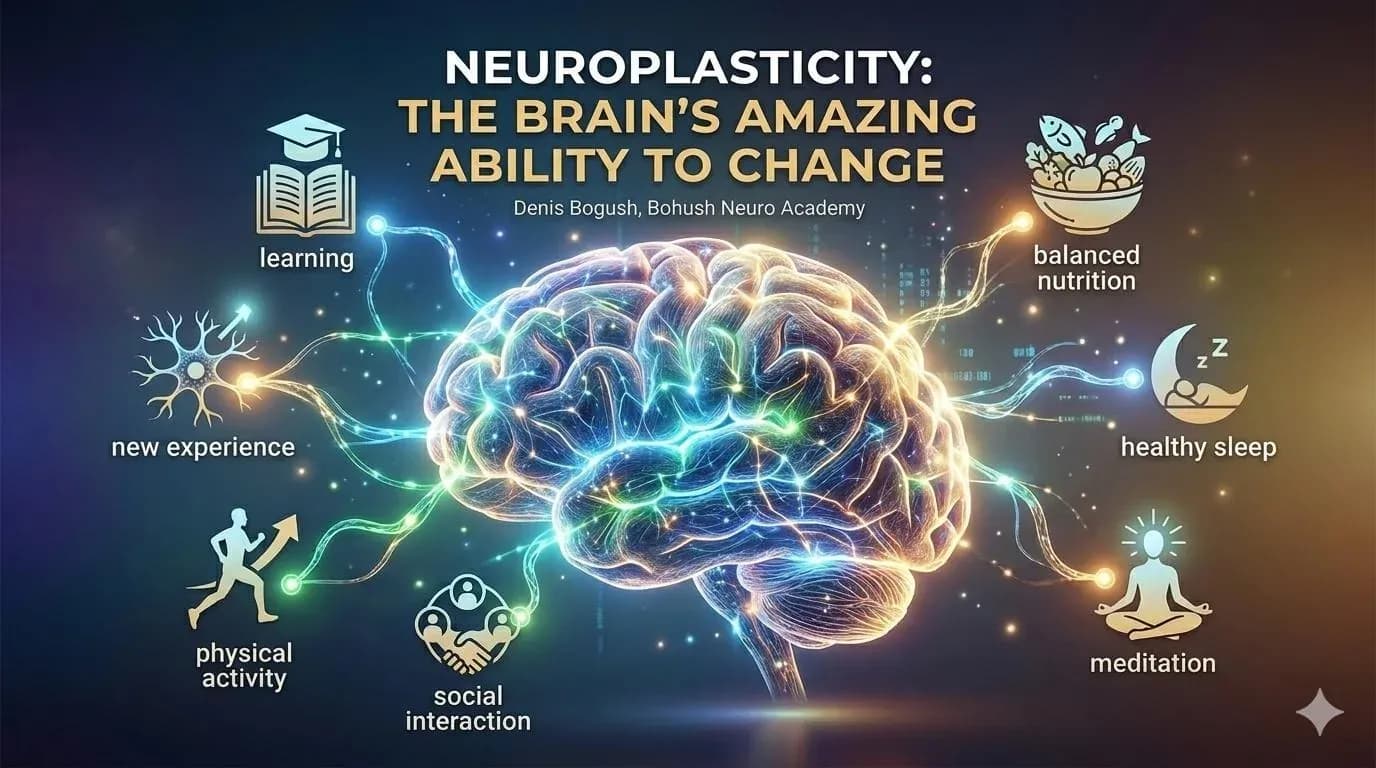
Brain plasticity is not a constant — it strengthens or weakens depending on how we live. Below are six lifestyle factors with the strongest scientific support.
Cognitive Training and Learning
Mastering new skills — a foreign language, a musical instrument, a complex game, or a new profession — literally lays down new neural pathways and raises what is known as cognitive reserve: an extra "margin of safety" for the brain that helps compensate for age-related losses or the effects of disease. People who maintain an intellectually active life over the decades consistently show a lower risk of developing cognitive disorders later in life. What matters is not simply repeating what is already familiar, but regularly stepping outside one's comfort zone — the brain changes most actively when it faces novelty and a manageable challenge.
Physical Activity
The link between movement and the brain is one of the best-established findings in neuroscience. Exercise, especially aerobic exercise, stimulates the production of brain-derived neurotrophic factor (BDNF), a protein that supports the growth of new neurons and synapses and improves the survival of nerve cells. At the same time, exercise improves blood flow to the brain, supplying the hippocampus with oxygen and nutrients, lowers cortisol (the stress hormone), and reduces the systemic inflammation that damages neurons. In practice, a combination of different types of activity works best: aerobic exercise (running, swimming, cycling) most effectively raises BDNF; strength training lowers stress and supports hormonal balance; complex coordination activities — yoga, dancing, martial arts — additionally train the cerebellum and the connections between different cortical regions; and short interval workouts stimulate cognitive function through the alternation of exertion and recovery. Even 20–30 minutes of moderate activity a day can measurably affect brain plasticity.
Social Interaction
Regular face-to-face interaction is a full workout for the brain. Discussion, joint problem-solving, and the need to understand another's viewpoint while articulating your own activate the limbic system and the prefrontal cortex, training both emotional intelligence and memory. Social isolation, by contrast, is a recognized risk factor for depression and dementia. Board and role-playing games, team sports, group dancing, book clubs, and volunteering are all forms of social activity that stimulate several cognitive systems at once and raise levels of oxytocin and dopamine, creating favorable conditions for forming new neural connections.
Balanced Nutrition
The brain consumes a disproportionately large share of the body's energy, so the quality of its "fuel" matters. Fatty fish (salmon, mackerel, herring), rich in omega-3 fatty acids, support the structure of neuronal cell membranes. Nuts, seeds, and berries supply antioxidants and polyphenols that protect nerve cells from oxidative stress. Whole grains provide a steady supply of glucose, the brain's primary energy source, while dark leafy greens, eggs, avocado, and legumes add folate, choline, and magnesium, which are important for neurotransmitter metabolism and for reducing inflammation. Mediterranean-style diets, which combine these elements, are associated in numerous studies with a reduced risk of cognitive decline.
Healthy Sleep
Sleep is not a passive "shutdown" of the brain but a period of some of its most active internal work. During slow-wave sleep, synapses formed during the day are strengthened, and the glymphatic system clears metabolic waste that has accumulated during waking hours. During rapid eye movement (REM) sleep, emotional memories are consolidated, creative thinking is activated, and connections between different brain regions are strengthened. A full sleep cycle lasts roughly 90 minutes, and quality neuroplasticity requires cycling through several complete cycles each night — meaning adults need at least 7–9 hours of sleep, a consistent sleep and wake schedule, and a dark, quiet, cool sleep environment that supports melatonin production. Chronic sleep deprivation, by contrast, suppresses BDNF production and weakens the brain's ability to form new connections.
Meditation and Mindfulness
Regular meditation practice is one of the few non-pharmacological tools for which measurable structural changes in the brain have been documented: increased gray-matter density in regions responsible for attention, memory, and emotional regulation, along with heightened activity in the prefrontal cortex. Meditation lowers cortisol levels, giving the brain a break from chronic stress and creating favorable conditions for forming new connections; it trains the ability to voluntarily sustain attention; and it strengthens neural networks associated with empathy. Some studies also link regular practice to slower shortening of telomeres — the protective end-sections of chromosomes associated with cellular aging — which is especially relevant for neurons, which renew themselves far more slowly than cells in most other tissues.
When Plasticity Works Against Us: Limits and Challenges
It's important to understand that neuroplasticity is a neutral mechanism, not a guarantee of only positive change. The same "use it or lose it" principle that lets us learn a new language is equally effective at reinforcing bad habits, anxious thought patterns, or addictions — the brain is just as willing to lay down harmful neural pathways as beneficial ones, as long as we regularly activate them.
Plasticity also naturally declines with age: the number of active neurons and synapses decreases, neurotransmitter levels fall, blood flow to the brain slows, and over time pathological protein deposits can accumulate. Chronic stress, anxiety, and depression further suppress plasticity by altering the structure of the hippocampus and prefrontal cortex — though, encouragingly, these changes are largely reversible: psychotherapy, training, and a healthy lifestyle can help the brain recover.
A distinctly modern threat to neuroplasticity is so-called "TikTok syndrome," or "clip thinking": the constant consumption of short, easily digestible fragments of information trains the brain toward instant gratification and weakens the capacity for sustained, focused attention. A related phenomenon is digital amnesia — the habit of relying on a smartphone and search engines instead of one's own memory gradually weakens memorization skills, since the brain, like a muscle, weakens without regular exercise. This does not mean technology is inherently harmful, but it does demand conscious, measured use if we want brain plasticity to work for us rather than against us.
Neuroplasticity and the Prevention of Cognitive Disorders
One of the most important practical applications of neuroplasticity research is the prevention of dementia, Alzheimer's disease, and Parkinson's disease.
The key idea here is the concept of cognitive reserve: the more alternative neural pathways and connections the brain has built up over a lifetime through learning, social engagement, and new experiences, the better it is able to compensate for the loss of neurons that inevitably occurs with age or illness. People with high cognitive reserve retain mental clarity longer even in the presence of significant neurodegenerative changes in the brain — because their nervous system has "backup routes" available.
Regarding Parkinson's disease, researchers pay particular attention to the role of exercise: aerobic activity stimulates the formation of new neural connections and supports dopamine production, the neurotransmitter whose deficiency underlies the disease's motor symptoms. Regular physical and cognitive activity is associated with slower symptom progression and a better quality of life for patients.
In other words, the same principles that make the brain more flexible and efficient in youth become, in adulthood and old age, a tool of prevention — not merely a "healthy habit."
Measuring and Applying Neuroplasticity in Practice
In the research laboratory, neuroplasticity is studied using neuroimaging methods — functional and structural MRI, electroencephalography (EEG) — along with cognitive tests and biochemical markers such as blood BDNF levels. In everyday life there is, of course, no direct "measuring instrument" for plasticity, but indirect indicators include progress in learning new skills, the speed of recovery after injury or illness, and a subjective sense of mental clarity.
In practice, consciously training neuroplasticity comes down to a handful of consistent habits:
- Learn something new every day, even in small doses: a word in a foreign language, a musical phrase, a fact from an unfamiliar field.
- Pair physical activity with a cognitive challenge — for example, learn a walking route instead of relying on a navigation app, or count your steps while jogging.
- Maintain regular social contact and deliberately seek out conversations with people whose views differ from your own.
- Keep a consistent sleep schedule of 7–9 hours.
- Practice meditation or mindful breathing for at least a few minutes each day.
- Eat a balanced diet, with an emphasis on omega-3s, antioxidants, and whole foods.
- Consciously limit time spent on "clip"-style content consumption, and train your capacity for sustained, focused attention.
None of these steps is a "magic pill" on its own — the benefit comes from their systematic combination over an extended period.
Conclusion
Neuroplasticity is the scientific confirmation that the human brain is not "programmed" for life at any given age. It is a dynamic system that rebuilds itself every day in response to what we do, what we learn, how we move, who we talk to, what we eat, and how we sleep. This flexibility explains why we are able to master new things at any age, why rehabilitation after severe injury often achieves results once considered impossible, and why lifestyle has such a profound impact on preventing age-related cognitive disorders.
At the same time, plasticity is not an automatic guarantee of progress: it reinforces harmful patterns just as readily as useful skills, which is why it demands a conscious, deliberate approach. Understanding the mechanisms of neuroplasticity turns the abstract advice to "train your brain" into a concrete, evidence-based plan of action. It is not magic — it is the result of daily conscious choices, and you can start changing your brain today.
Outside Resources
- Norman Doidge, The Brain That Changes Itself: Stories of Personal Triumph from the Frontiers of Brain Science — a popular-science book with detailed clinical stories of neuroplasticity.
- Norman Doidge, The Brain's Way of Healing: Remarkable Discoveries and Recoveries from the Frontiers of Neuroplasticity — on unconventional paths to brain recovery.
- Jeffrey Schwartz and Sharon Begley, The Mind and the Brain: Neuroplasticity and the Power of Mental Force — on the role of conscious effort in reshaping the brain.
- Eric Kandel, James Schwartz, Thomas Jessell, Principles of Neural Science — a foundational neuroscience textbook for those who want to go deeper into cellular mechanisms.
- Harvard Medical School, A Guide to Cognitive Fitness (Harvard Health Publishing special health report) — a practical overview of evidence-based methods for supporting cognitive health.
- Denis Bohush, Brain Training: Improving Memory, Developing Consciousness, Prevention of Cognitive Disorders — a practical guide to brain-training exercises at every level of difficulty.
Discussion Questions
- Give an example of a skill you learned as an adult. What signs would you point to that your brain physically changed during that learning process?
- Why should the "use it or lose it" principle be considered both an advantage and a potential danger of neuroplasticity?
- In your view, how does the habit of constantly turning to a smartphone for information affect your own long-term memory and attention?
- Of the six factors that stimulate neuroplasticity (learning, movement, social interaction, nutrition, sleep, meditation), which is the weakest part of your own routine — and what makes it hard to change?
- Why is the concept of cognitive reserve important for understanding why two people with the same degree of age-related brain change can show very different levels of cognitive symptoms?
- How might knowing that the effects of chronic stress on the hippocampus and prefrontal cortex are reversible change the approach to treating anxiety and depression?
- If you were designing a dementia-prevention program for older adults in your community, which principles of neuroplasticity would you build it around?
Vocabulary
BDNF (brain-derived neurotrophic factor) — a protein that stimulates the growth, survival, and formation of new connections between neurons; its levels rise during physical exercise.
Cognitive reserve — the brain's capacity to compensate for age-related or pathological loss through alternative neural pathways built up through learning and an active lifestyle.
Cortisol — the stress hormone; chronically elevated levels suppress neuroplasticity and damage the hippocampus.
Digital amnesia — the weakening of memorization skills caused by the habit of relying on external digital sources (smartphones, search engines) instead of one's own memory.
Functional (cortical) plasticity — the ability of different regions of the cortex to redistribute functions among themselves, particularly after injury or the loss of a sense.
Glymphatic system — the network that clears metabolic waste from the brain, most active during deep sleep.
Hippocampus — a brain region critical for forming new memories, spatial orientation, and learning; one of the few areas where adult neurogenesis has been confirmed.
Long-term depression (LTD) — the lasting weakening of a synaptic connection resulting from infrequent or uncoordinated neuronal activity.
Long-term potentiation (LTP) — the lasting strengthening of a synaptic connection resulting from intense joint activity between two neurons; the cellular basis of learning and memory.
Mirror neurons — neurons that activate both when performing an action and when observing that action performed by someone else; involved in learning through imitation and in empathy.
Neurogenesis — the process of forming new neurons from neural stem cells; in adults, confirmed primarily in the hippocampus.
Neuroplasticity — the brain's capacity to change its structure and functional organization throughout life in response to experience, learning, environment, or injury.
Prefrontal cortex — the front part of the frontal cortex, responsible for planning, self-control, and conscious decision-making.
Structural plasticity — the physical rebuilding of neurons: the formation of new dendritic spines, axon branches, or neurons.
Synapse — the point of contact between two neurons through which a signal is transmitted.
Synaptic pruning — the process of "trimming" rarely used synaptic connections, which makes neural networks more efficient.
Synaptogenesis — the process of forming new synapses between neurons.
Sources and Recommended Reading
- Kandel, E. R., Schwartz, J. H., & Jessell, T. M. Principles of Neural Science (4th ed.). New York: McGraw-Hill Medical Publishing Division, 2000.
- Salthouse, T. A. The Aging Mind: How Biological Aging Influences Cognition. Psychology Press, 2019.
- Doidge, N. The Brain That Changes Itself: Stories of Personal Triumph from the Frontiers of Brain Science. Viking Adult, 2007.
- Doidge, N. The Brain's Way of Healing: Remarkable Discoveries and Recoveries from the Frontiers of Neuroplasticity. New York: Viking Penguin, 2015.
- Schwartz, J. M., & Begley, S. The Mind and the Brain: Neuroplasticity and the Power of Mental Force. New York: HarperCollins Publishers, 2002.
- Harvard Medical School. A Guide to Cognitive Fitness. Special Health Report. Harvard Health Publishing, 2024.
- Bohush, D. Brain Training: Improving Memory, Developing Consciousness, Prevention of Cognitive Disorders. Bohush Neuro Academy, 2025.

About the Author

Dr. Denis Bohush
Neurologist, neuropsychologist, author of the metahypnosis concept, military expert
Denis Bohush is a neurologist, neuropsychologist, and founder of Bohush Neuro Academy, an educational project devoted to popularizing neuroscience and practical brain-training methods. He is the author of Brain Training: Improving Memory, Developing Consciousness, Prevention of Cognitive Disorders, which systematically lays out approaches to preserving cognitive health at any age.
- Kyiv Medical University — qualified as a neurologist
- Yale University (USA) — training in psychology
- Military Institute, Taras Shevchenko National University of Kyiv — training in psychology
How to cite
APA
Bohush, D. (2026). Neuroplasticity: the brain’s amazing ability to change. Bohush Neuro Academy. https://bohushneuro.com/en/blog/neyroplastychnist